



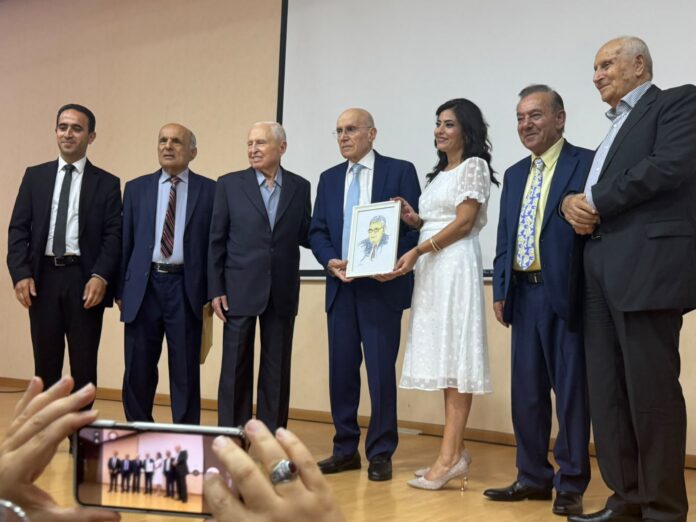

In Memory of Dr. Ibrahim Baydoun (1941–2025)
Address by Dr. Kamel Mohanna
President of Amel Association International
General Coordinator of the Lebanese NGO Forum
Delivered during the commemorative seminar honoring the life and intellectual legacy of the late historian and writer Dr. Ibrahim Baydoun (1941–2025), held as part of the Quarterly Tribute Series to Lebanese Writers. The event was organized by the Lebanese Writers’ Union in collaboration with the Cultural Forum, hosted by the Association for Specialization and Scientific Guidance, and also marked the launch of the sixth issue of the Union’s journal.
Wednesday, 8 July 2026 – 5:00 p.m.
Association for Specialization and Scientific Guidance
Jnah, Beirut, Lebanon
My Brother, Dr. Ibrahim,
I never imagined that one day I would stand at a podium to mourn you. You were the master of podiums—the eloquent speaker, the gifted orator, the poet and man of letters whose words sprang from the deepest wells of the soul and the oldest roots of our language.
I never imagined that I would be the one illuminating your life before friends and colleagues, when you were the one who devoted his life to illuminating history and civilization, time and place. You knew far better than I how to enlighten the human spirit. Together we sailed through the boundless sea of words, reaching their highest meanings. Amel drew from you its ideas, its vision, and its guidance. How could it not, when you devoted yourself so passionately to its growth, enriching it with the very best you had to offer? As its Secretary General, you remained steadfast in your commitment from its very founding until the very last breath of your life.
Today we remember you as we endure some of the darkest days of our history. I know your spirit remains in Bint Jbeil, and that even the explosions of missiles and the cries of shattered buildings cannot defeat the soil that embraced you. You built towers for memory there and raised clouds of knowledge whose rain reached every corner of the world. To those looking from afar, the devastation may evoke the image of Hiroshima. Yet the human spirit knows no chains, stops at no checkpoint, and no fire or criminal hand can ever reach your soul.
My dear Abu Ali,
It is not easy for me to bear the weight your absence has left in my heart. One cannot strip half a century of companionship and shared purpose from one’s blood. Half a century of unwavering loyalty that time itself could not erode; a friendship untouched by discord. From the very beginning, we were united by a purpose that neither the hardships of life nor the fires of war could shake: to serve humanity, to stand beside the marginalized, the oppressed, and the poor, and to serve every citizen of Lebanon, regardless of religion, identity, political affiliation, or conviction.
Together we embarked on what seemed an impossible journey. In 1979, we founded Amel from nothing, nurturing it despite every obstacle and every thorny path. You carried the burden of that journey with me, just as I carried it with you, long before the institution grew—and before we ourselves grew with it. Despite every hardship, we smiled together whenever we saw Amel spread its wings across the world, establishing its presence in country after country and raising its banner over more than fifty centers throughout Lebanon.
Together we built what has become this remarkable institution, sustained today by the dedication of 1,800 young women and men. They listened to you, learned from you, and spoke with you in affection and respect. They understood that you were one of Amel’s indispensable pillars, and they continue to draw inspiration from the legacy you left behind. They asked me today to convey to the noblest of souls their warmest greetings.
My friend,
You were a light that illuminated more than one path. You were a thinker who approached history with intellectual courage, openness, and a spirit of free inquiry. You devoted yourself to the study of Islamic history with a critical and independent mind—accepting one interpretation, revising another, challenging yet another—because you were never born into unquestioning acceptance of prevailing narratives.
Your rebellious father, who had participated in the historic Tobacco Revolt and who kept company with poets, intellectuals, and advocates of freedom resisting oppression and occupation, shaped that independent spirit within you. It was he who first introduced you to the world of poetry, nurturing in you a lifelong love of literature.
Yet when you entered university, you chose history. Perhaps that choice was born of the vibrant intellectual debates that animated Lebanon during the 1960s. You pursued history with passion and later taught it not as a routine profession, but as a lifelong vocation. In time, you became one of the few historians whose names history itself will remember.
You went on to chair the Department of History at the Lebanese University and became one of the Arab world’s most distinguished historians. You were awarded the title of “Arab Historian” by the Union of Arab Historians, received the First Prize at the Imam Ali Festival in Iran, and were honored by the Islamic Cultural Center under the patronage of the late Sayyed Mohammad Hussein Fadlallah. Your scholarly work also earned the admiration of the late Sheikh Mohammad Mahdi Shamseddine.
Your book The Revolution of Imam Hussein: Event and Problematics came as a profound shock to many readers accustomed to traditional Ashura narratives, who struggled to accept its boldness. Yet this did not deter you. You anticipated the controversy and understood that your intentions might initially be misunderstood. You therefore followed it with further scholarly works that gradually softened the initial reaction and invited readers toward the deeper understanding you sought to offer of Imam Hussein’s character—through calm analysis, rigorous scholarship, and a compelling style.
This was your hallmark. You wrote about Islamic political thought with scholarly clarity and intellectual integrity, far removed from emotional rhetoric and the controversies it often generated. Guided solely by your convictions as an objective researcher, you remained faithful to evidence and scholarship above all else. It was this commitment that earned you the respect of people across different schools of thought, despite your willingness to engage with some of the most sensitive and controversial issues of our time.
And because you always sought to move your readers as well as inform them, you drew upon your literary gift to soften the austerity of historical writing. Your elegant, profound, and remarkably fluid command of the Arabic language enabled you to illuminate even the most complex historical texts with exceptional clarity.
My friend, my soulmate.
You were never one of those who squandered time or allowed themselves to be confined by a discipline, a profession, or a way of life. The nearly two hundred books, scholarly studies, translations, and research papers you produced and presented at conferences in Lebanon and across the Arab world are testimony enough to your remarkable intellectual legacy. You enriched them further with your journalistic writings during your experience with As-Safir newspaper, where our late mutual friend, Talal Salman, warmly welcomed your contributions.
As a son of Jabal Amel, you immersed yourself in the literary history of your homeland, keeping company with its celebrated poets—both the “wayward” and the turbaned scholars. Yet your passion knew no limits. You committed to memory countless poems by the great Arab poets whose works marked memorable stations along your intellectual journey. Time and again, you spoke to me of many poets and no small number of novelists whose literary worlds you explored with extraordinary depth and appreciation.
My friend,
Neither of us ever underestimated the importance of political parties and their role in Lebanon’s political life—as indeed elsewhere in the world. Yet together we chose to devote our greatest energies to humanitarian work.
At Amel, we were privileged to have you as a true partner. You enriched the institution with your ideas and thoughtful counsel, actively participated in its activities, welcomed with us delegations of supporters from around the world, and served as a trusted guide in shaping our concepts, refining our vision for the future, and exploring new approaches to renewing the work of humanitarian organizations and civil society.
Alongside this commitment, you remained deeply engaged with another institution that played a major role in advancing committed cultural life and showcasing the rich heritage of Jabal Amel and southern Lebanon—its history, its present, and its future: the Cultural Council of Southern Lebanon, led by our late friend Habib Sadek. As its Vice President, you served with distinction and unwavering dedication.
My friend,
How fortunate I was to have first met you in Grenoble, France, when I was President of the General Union of Lebanese Students and you were among its members. We were young men whose hearts remained close to our homeland—as close as Bint Jbeil is to Khiam—thinking together about Lebanon and the concerns of its people.
That was our first meeting, before fate brought us together again to embark on the adventure of founding Amel, as I have already recalled, and to forge a friendship that was never weakened by occasional differences of opinion. On the contrary, those differences only strengthened the bond between us.
Our partnership was built upon loyalty, sincerity, and mutual trust. Our purpose, from beginning to end, was profoundly humanitarian.
As your writings became a beacon in the field of history, you grew only more humble, more transparent, and more generous in spirit. Our daily conversations often became cherished moments of respite, where we brushed away the dust of exhaustion, reflected on politics and society, and effortlessly wandered from philosophy to laughter.
Our two families became one family.
Today, we pledge to Umm Ali, to your daughters Sirine, Kinda, and Alia, and to your son Ali, that we shall remain together, united by your cherished memory, gathered around the beautiful image you have left in our hearts. We shall continue to draw inspiration from your life and your journey, from your ideas and your vision, from the legacy you created and the influence you continue to exert. We look toward you now as you rest in the highest heavens.
My brother, my friend, my beloved,
At last, I can tell you nothing but the truth.
I have not yet learned how to tame the emptiness your departure has left within me. It remains a heavy darkness, a grief that never dries, and an anxiety that trembles upon the eyelids.
And so, I will not bid you farewell, for you continue to dwell within my heart—morning and evening.