



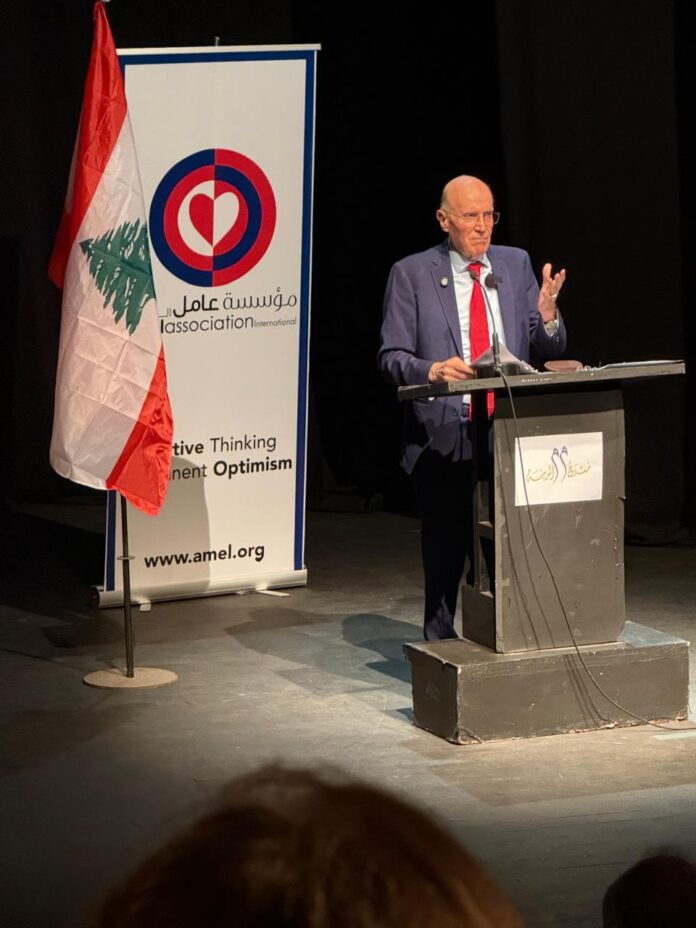

Intellectual Lecture:
Dignity as a Collective Act
The Role of Amel International in Building the Human Being and Safeguarding Freedom
Dr. Kamel Mohanna
President of Amel International
General Coordinator of the Gathering of Voluntary Associations in Lebanon
City Theatre, Beirut
29 January 2026
Friends,
I begin where any talk about dignity and freedom must begin, with culture, with theatre, with this very place that the artist Nidal Al-Ashkar insists must remain a space for thinking and free art, and a platform to resist despair and defeat, at a time when people are being pushed to surrender and give up their rights in order to “stay safe,” yet they do not become safe.
Thank you to City Theatre, this historic institution that was never merely a stage for performances, but has always been a theatre of awareness, knowledge, and creativity, a forum for difficult questions, and a refuge for free thought in Beirut and Lebanon. Here, where the word resisted repression, and where theatre confronted colonialism, mediocrity, and fear, culture preserved its role as a first line of defense for the human being.
And my deepest thanks, appreciation, and gratitude to the lady of theatre, daughter of a house of struggle, one of the shields of culture in the face of the enemies of the nation, a voice that never compromised, a mind that never broke, and a presence that embodied what it means for culture to be an ethical political act, not decoration, not luxury. Nidal Al-Ashkar is not only a name in the history of theatre, she is a long experience of struggle, one that has proven, and continues to prove, that culture can protect freedoms when politics abandons them.
After this thanks, allow me to ask a question that is simple in form, profound in meaning, what do you know about “Amel”?
What do you know about this movement that has become international in every sense, how did it begin, why, for what purpose has it continued and continues, and for what reasons is it able to endure?
Amel’s centers, now more than forty, its diverse programmes, its mobile clinics, its roaming educational units, and its initiatives that care for children living on the streets, operate today in a living and continuous harmony across most Lebanese regions, the same regions that carry the scars of civil wars, a memory heavy with pain, and a broken social contract that has not yet healed.
And yet people there meet on one thing, trust in Amel. They cooperate with it, work alongside it, and open to it their homes and their hearts, because they see in it something that goes beyond a service, a programme, or a project. They see meaning.
So what does Amel represent to them, is it merely an institution, or is it, at its core, a citizenship project being rebuilt from the social base, where politics failed and the public contract shattered?
That is why I am here today, not to present a complete experience or a ready-made model, but to reflect together on this journey, a journey with much we can learn, and, before that, a wider space for what you can add to it, because Amel was never a closed project, it is a living movement that feeds on people, and grows through them.
Amel was not born from a surplus of power, not from an administrative decision, not from dazzling funding. It was born as a response to a human cry, an objection to the civil war, and to the logic of killing and division. It was born as a rejection of sectarianism and of deadly sub-identities, and as a belief that a person is not reduced to an affiliation, and that dignity is neither divided nor postponed.
In 1979, when shells were tearing apart suburbs, camps, and villages, we did not wait for the storm to quiet. We entered it. We entered it as doctors, volunteers, and intellectuals, carrying first-aid bags and ideas that were both simple and profound, that humanitarian work is the most truthful form of resistance, and that solidarity is not charity, it is an act of liberation. Thus, Amel was born as a non-sectarian civic social movement, not created to distribute aid, but to restore the human being as an absolute value, and to work to safeguard dignity, secure rights, and recognize that building a more just and more humane world requires the struggles of people who ask nothing for themselves, and who do not withhold from others the overflow of their giving, whatever the cost, and without any return.
From the first moment, we did not separate emergency relief from development, nor support from change. We entered the popular neighborhoods, the South, the Bekaa, Beirut and its suburbs, where the state was absent, or made absent. There we planted our first centers, and launched health, educational, and development projects, not because we possessed ready solutions, but because we believed that building the human being is the only real politics possible in a country torn by politicians.
Amel’s philosophy was, and remains, simple in its phrasing, deep in its essence, optimism is a craft, hope is a صناعة, and surrender is not destiny. Therefore, Amel was not a service association, it was a liberation movement for change, working to build the human being and safeguard freedom, because it understands that freedom is not protected by weapons alone, but by العقل, by awareness, and by dignity. Yes, Amel engages in the core of the political struggle, but it does so from a different position, from the bottom up, from people to policies, from the wound to action. We believe real change is not imposed from above, it is built from the social base.
During the years of the civil war, Amel’s role focused on saving lives, providing emergency services, and standing in solidarity with the human being regardless of affiliation. In field hospitals and temporary clinics under bombardment, one of the great ethical pillars of our philosophy was established, a person is not asked about identity while bleeding, and justice begins in the field, not in conferences. In parallel, programmes for empowering women and youth were launched, along with campaigns for social peace, ending the war, and protecting the national fabric. From the beginning it was clear that response was not an end, but a starting point for a bigger question, why does tragedy repeat, and why does injustice remain?
After the war, and with the beginning of the 1990s, Amel moved to expand development and empowerment programmes, reaching broader groups, more regions, and deeper specializations, contributing to rural development at all levels. In this phase, we did not limit ourselves to providing services, we launched initiatives to consolidate the concept of citizenship, build a new culture in society, and strengthen the role of civil society as a critical force that corrects public policies. We were not a substitute for the state, but a critical partner reminding it that its first duty is to protect the human being.
With the start of the new millennium, Amel began to acquire an international dimension, in recognition of its efforts to bring legitimate human causes to global platforms, and to represent Lebanon in international forums. Our global partnerships expanded under the slogan “Partners, not guardians,” because we refuse to be followers, and we refuse for Lebanon to be reduced to the image of a permanent recipient of aid. In this stage, local experience became transferable knowledge, and the nation was required to be a producer of meaning, not a consumer of it.
From 2010 until today, Amel has contributed to leading humanitarian resistance, launching a global solidarity movement with marginalized groups, and transferring its experience to the world and to developed countries. It established branches in Europe and the United States, alongside its role in Lebanon in containing the refugee crisis, economic collapse, the COVID-19 pandemic, and repeated wars, after its relationships deepened with many international humanitarian institutions and influential activists worldwide who expressed a desire to cooperate with the institution to transfer its experience as a successful Eastern model to the West. In this way, Amel became the first Lebanese humanitarian organization to defy the rule of Eastern dependency on the West, since it is usually Western institutions that open branches in the East, not the opposite. Amel went in the opposite direction and began exporting its model to the West. This path led to Amel being nominated repeatedly for the Nobel Peace Prize, not as a coronation, but as international recognition of a cross-border liberation trajectory, and it is today nominated for the tenth consecutive year.
Across the entire history of this experience, dignity was never a slogan raised on occasions, nor a speech summoned in crises, it was a social liberation act practiced daily, in small details before major headlines. In Amel’s path, dignity was not reduced to defending rights on paper, it was embodied in how we stand beside people when they are marginalized, in how we listen to them as partners not recipients, and in our insistence that humanitarian action be an instrument of liberation, not the management of misery. Dignity appeared in every center opened in a forgotten area, in every mobile clinic that reached places where the state was absent, and in every initiative that restored people’s confidence in themselves and their ability to act. It is dignity built collectively, through shared work, by turning solidarity into practice, assistance into an equal relationship, and need into an opportunity to reproduce meaning. In this sense, dignity is neither an individual condition nor a purely moral demand, but a long-breath liberation journey that seeks to free the human being from poverty, fear, and dependency, and to place them in the position of an actor in society, not a permanent victim. From here, dignity becomes a political act par excellence, not because it seeks power, but because it redefines politics itself as care for life, building the human being, and safeguarding freedom through continuous collective action.
Esteemed audience,
Let us ask ourselves, how did Lebanon endure everything it has been through, not because the Lebanese “adapt,” but because there is a silent power in society, born of ordinary people, of an astonishing ability to turn pain into strength, and tragedy into beautiful patience. This is the other face of Lebanon, a Lebanon that does not scream, it rises. It can be seen clearly in the experience of Amel, born from the war, to craft one of the most beautiful chapters of human resilience.
In Amel’s dictionary, response is not technical work, nor merely a humanitarian reaction, it is an existential position, and the first form of resistance when the public order collapses. We did not stop at response, we moved to structural action, to development, to dismantling the causes of need rather than managing its results. Limited resources became a constant source of creativity, mobile clinics instead of destroyed hospitals, small schools instead of closed classrooms, vocational initiatives instead of temporary aid. Hope, in our philosophy, is not a feeling, it is a profession, and creativity is a form of resistance.
Thus, humanitarian work in Amel became an ethical liberation political act, not partisan, linking social justice, democracy, and citizenship. I summarized this path in one phrase, dignity is the only viable political programme. Liberation, in Amel’s thought, is not a slogan, it is a continuous historical social process, liberation from poverty, ignorance, dependency, and from turning the human being into a tool in the game of power.
With the accumulation of experience, Amel transformed from a noble intention into a liberation social movement with complete features, with a clear intellectual vision, an organizational structure, a collective identity, and an audience engaged in a long-term project of change. This identity was built on three intertwined circles, the human being first, because no sect stands above dignity, the second nation, because Lebanon cannot be built except on citizenship, and universal humanity third, because justice does not fragment.
In a country exhausted by sectarianism and patronage, this institution represented a moral and practical opposite to this system. It built a human fabric that crosses sects, and made each center a space for citizenship, and each volunteer a social actor, not merely an executor. Amel’s path did not stop at Lebanon’s borders. It carried its thought and project beyond geography, opened centers, and planted the fruits of its experience in several countries around the world, from Europe to the United States, and it is preparing today to expand its presence in other regions. Amel did not go abroad in search of recognition or positioning, it carried with it the experience of the South and Lebanon as knowledge, and humanitarian work as a liberation act.
In Europe, as elsewhere, trust in Amel was built on clarity of position, not on compromise. It is, in its essence, an anti-colonial institution, carrying the concept of “humanitarian resistance,” and seeking to liberate humanitarian work from colonial thinking that often turned it into an instrument of control rather than an instrument of justice. From this standpoint, Amel entered the West not as a follower, but as a fully equal partner, cooperating with its institutions and governments for the good of people, and channeling these partnerships in service of Lebanon and just human causes, without accepting negotiation over freedom, sovereignty, or justice, in Lebanon or anywhere in the world.
It is precisely this moral clarity that distinguished Amel globally, when it made work for the Palestinian cause, as the most just humanitarian cause of our time, an ethical standard for humanitarian work itself, in an era when many preferred to appease the West and donors and to neutralize justice from humanitarian action. For Amel, what is right cannot be negotiated, and humanity cannot be separated from position, because dignity, when fragmented, loses its meaning, and when bargained over, becomes an empty slogan.
Amel lived the hardest conditions, and mastered the battles of humanitarian, social, and development work with high professionalism, and clear understanding of its role, keeping in sight the dignity of people humiliated by the war machine, devoured by the greed of traders, and wounded by the fangs of savage capitalism. This institution was not weakened by the disasters that struck Lebanon, from the civil war, to enemy invasions, to waves of violence it sent into Lebanon, to waves of terrorism that spread fear across more than one region. None of this made us surrender or despair. We kept raising our sail and cutting through the depths of the human experience, optimistic about the future. Our numbers did not decrease, the hardships increased our determination to continue the path we chose from the beginning, in victory for human dignity and the right to a just, dignified life.
Finally, what I presented today was not the telling of a finished experience, nor a celebration of a complete trajectory, but an attempt to convey lessons learned from a long journey of liberation humanitarian work. A journey that taught us that dignity is not granted, it is seized through collective action, and that change does not start from major institutions, but from small convictions that turn into daily practices. I wanted to place this experience in your hands, not as a model to imitate, but as an open space for thinking, and an invitation for each of you to ask, where am I in this path, and how can I be part of this experience, support it, or even initiate a similar experience in my environment and community?
Your responsibility is not limited to sympathy or admiration, it is about courage, the courage to turn anger into organized action, disappointment into a project, and a question into an initiative. The courage to move from being a spectator to being an actor, and to believe that change, however small it may seem, is a political and ethical act at the same time. Amel was never the property of a single generation, nor the monopoly of an institution, it was, and remains, an open invitation to everyone who rejects injustice, and believes that dignity is not a slogan raised, but a daily practice built with patience and work, and that building the human being is the most sincere and most sustainable path to safeguarding freedom and creating a future worth living.