




Amel Association as a Social Movement: From Humanitarian Action to Structural Uplift or
By Dr. Kamel Mohanna |Founder and President of Amel Association International
Since its founding in 1979, Amel has stood not merely as a humanitarian organization, but as a progressive social movement rooted in the struggles of people for justice and dignity. It emerged during a defining historical moment, the Israeli invasion of Lebanon, with a bold vision to pioneer a new model of social engagement: one that transcends service provision to transform the very fabric of society.
The broad presence of Amel centers across Lebanon, particularly in areas most scarred by the civil war, carries both symbolic and strategic weight. This distribution was no coincidence; it was a deliberate effort to overcome the geography of conflict and fragmentation by drawing an alternative map grounded in solidarity, justice, and human connection. Amel’s mission is carried out through participatory fieldwork, driven by a predominantly young team, 80% of whom are women and girls, comprising both full-time staff and volunteers, many serving as leaders within their own communities. Amel is, above all, a space for nurturing leadership and building collective resilience.
Throughout history, social movements have emerged as turning points in shaping societies, from 19th-century liberation struggles to the civil, feminist, and environmental rights movements of the 20th century, and the transnational digital movements of the 21st. These movements have been interpreted through various theories: from classical theories focusing on psychological dynamics, to resource mobilization theory emphasizing organization and resources, and new social movement theories highlighting identity and culture.
Within both the global and Arab contexts, Amel’s emergence stands as a living embodiment of this broader historical trajectory. It began as a spontaneous response, led by myself alongside a group of volunteers and supporters, to the devastating consequences of the Israeli invasion of Lebanon, the collapse of state institutions, and the erosion of solidarity. Yet what started as an urgent reaction soon evolved, guided by Amel’s founding vision, into a comprehensive social movement, one with a clear agenda for change and practical tools to help build a more just and equitable society.
Amel and Social Change Movements: Theoretical Roots
Experience has shown that genuine social movements do not arise in a vacuum, but at the intersection of urgent need, collective will, and historical momentum. In this light, Amel stands as a vivid embodiment of new social movement theory, which emerged in the late 20th century to expand the scope of activism beyond economic demands, embracing questions of identity, justice, and liberation.
Through a vision that fuses relief with development and humanitarian action with social justice, Amel has become a collective force grounded in the everyday needs of people, an engine for reshaping social and political relationships. It is a living illustration of Alain Touraine’s theory of “cultural transformation,” where humanitarian engagement becomes a platform for cultivating new forms of collective consciousness that transcend sectarianism and clientelism.
At the Core of Amel’s Philosophy
Amel has consistently upheld the motto of “positive thinking and continuous optimism” in a landscape often marked by pessimism, inertia, and scattered energies. As a civil institution, it delivers social, health, legal, and culturally enlightening programs, anchored in a deep commitment to the human citizen, rejecting sectarianism, and embracing both national and pan-Arab dimensions.
Within both the national and Arab contexts, Amel serves as a “resistance mechanism” against social marginalization, poverty, injustice, and deepening inequalities, including the divide between rich and poor, as well as against the surrender of dignity by those who are most marginalized. Amel’s methodology is rooted in what we call the “three Ps”:
- (Principles) the institution believes in.
- (Positions) it takes to express those principles.
- (Practices) that ensure sustainability.
At the heart of Amel’s mission lies the unwavering defense of human dignity, every human being’s dignity. This principle is the cornerstone of all belief in human rights: the recognition that every person, by virtue of their humanity alone and regardless of affiliation, is entitled to a set of rights that must be upheld in all circumstances. These rights are not bestowed by any authority; they are inherent, born of dignity itself.
To protect this dignity is to affirm each individual’s freedom and sovereignty over their body, choices, and life path. It means empowering people, physically and intellectually, as Amel’s programs strive to do, so they may shape their own future, free from dependency or subjugation.
Pillars of the Roadmap to Achieve the Mission:
- Working with popular communities, as there is no democracy without development.
- Commitment to just causes, foremost among them the Palestinian cause.
- Struggling against double standards, especially between East and West.
- Fighting for fair distribution of wealth, nationally and globally.
- Building a state of social justice where the public sector oversees the private, and humanitarian organizations complement government shortcomings, becoming a pressure force for policies that serve marginalized communities.
- Protecting the environment and confronting climate change, which threatens the planet’s future.
Criticism is Easy, Art is Difficult
What sets Amel apart, beyond its rights-based and humanitarian vision, is its steadfast commitment to carefully crafted operational principles that shape its internal dynamics and its engagement with society. Amel is not simply a provider of programs or a responder to crises; it operates through a deliberate, structured approach designed to ensure both the effectiveness and sustainability of its interventions.
Building common ground in fractured societies requires foundational skills, chief among them attentiveness and responsiveness to others in the pursuit of shared understanding through dialogue. Yet today, public discourse is often dominated by self-aggrandizement, the demonization of others, and a tendency to accuse rather than empathize. Self-critique is largely absent, giving way to individualism, fragmentation, and a weakened collective spirit. Energy is too often expended on narrating reality rather than transforming it; slogans are echoed without earnest follow-through, while real progress is stifled by an “all-or-nothing” mindset that hinders compromise and collective action.
In response, Amel adopts a set of rules shaping institutional dynamics and relations with people, reflecting its deep belief in human capacity for change and cooperation:
- Trust in people. Experience determines whether this trust is well-placed, but the aim remains cooperation and developing others’ potential.
- Love for people. This builds common ground and generates empathy and compassion. Dialogue helps us understand complex issues, and responsiveness to others reflects human richness. Human collaboration potential exceeds what institutions allow. Lack of mutual understanding should not prevent engagement. We can build meaningful connections rather than seeing others as mere reflections of ourselves.
- Access to sufficient information (data) about any topic being addressed.
- Clear planning for every issue tackled.
- Recruitment of competent personnel to implement the plan.
- Evaluation and adjustment of the plan based on field experience.
From Aid to Action: The Empowerment Strategy
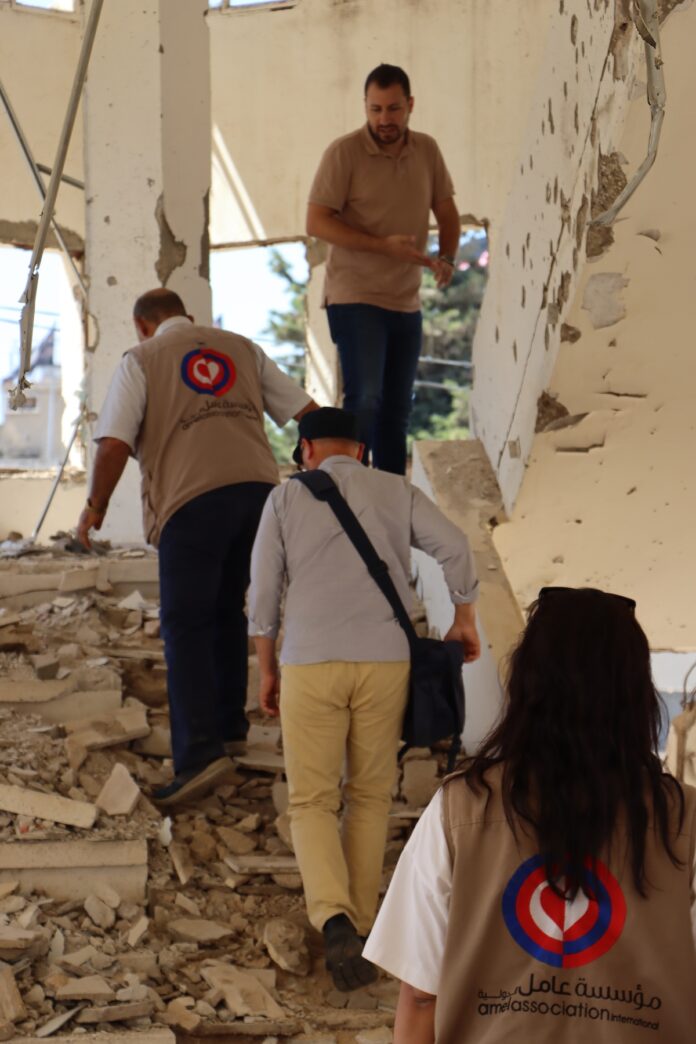
Amel views every human not as a passive recipient of aid, but as an active agent of change. Guided by this belief, it has embraced a gradual empowerment approach, focusing on the most marginalized populations through initiatives in health, education, child protection, and women’s empowerment. Every Amel center and mobile clinic serves as a hub for social mobilization, grounded in the conviction that dignity is not bestowed, it is earned through awareness, organization, and collective action.
This methodology draws on Resource Mobilization Theory, which asserts that the success of social movements lies in their ability to effectively harness both human and material resources. In this context, Amel is far more than a service provider; it is a living laboratory for constructing a more just and equitable society.
Social Protection: A Humanitarian Lens and a Tool for Transformation
Social protection must not be seen solely as a technical safety net but as a reflection of a society’s view of humanity. When humans are ends, not means, protection becomes a liberating act that reinforces dignity and justice.
Historically, social movements have been the guardians of this vision, advocating labor laws, health guarantees, and social security through workers’, feminist, and community struggles. Protection is not a gift from authority, it is a right earned through organization, awareness, and pressure.
Amel sees social protection as central to its mission, not merely through service provision, but by building a participatory social system where responsibility is shared between the state, civil society, and local communities to guarantee basic dignity and justice for all.
Resisting Disintegration: Protection as a Liberatory Act
In a world marked by social fragmentation, war, and excessive globalization, Amel’s experience restores the meaning of solidarity. Development, in Amel’s view, is not technical improvement but collective liberation from the grassroots.
By protecting vulnerable groups, women, children, migrant workers, and the elderly—Amel rebuilds the social safety net and redefines the relationship between the individual and the community. It is a movement resisting social disintegration, fostering belonging and nurturing citizens who actively shape their own futures.
Amel invites us to view social protection as a unifying national project, not exclusive to the state or humanitarian organizations but requiring all sectors (public, private, and community-based) to cooperate. Protection must go beyond service delivery to include policy change, expanded justice, and investment in knowledge to diagnose inequality and propose fair, sustainable solutions.
This demands a holistic approach linking individual rights with collective choices, local action with global vision, and field practice with academic analysis—transforming protection from crisis management into a driver for social renaissance. That is why the Amel model is a transformational horizon that can be adapted and expanded to uplift communities worldwide—where the human is not a problem to be solved, but the solution itself.
Amel as a Social Conscience for Justice
Amel is part of a long tradition of Arab and global social movements that resisted oppression and marginalization, seeking to rebuild society on foundations of justice and equality. In an era of shrinking public space and hollowed-out democracies, Amel insists on restoring the essence of the social contract: that people are agents of their own fate, not passive recipients of decisions.
In a world dominated by individualism and market logic, Amel represents a moral voice restoring the human conscience, not through slogans but through the cumulative impact of committed daily action. From care centers in villages, to empowerment in camps, to community dialogues in cities, it builds networks of hope and cohesion.
Amel is not an elitist project, it is a people’s movement, standing with them in their battle to reclaim dignity and meaning in a turbulent world. It is not just an organization—it is a living social conscience and a renewed liberation project. It is not an institution—it is a movement for liberation.
A Horizon for the Future
In a time of growing challenges and collapsing protection systems, Amel offers a renewed model of social protection—as a liberatory act and transformative project rooted in and for the people. In a region saturated with sectarianism and division, Amel—under the leadership of a young generation—has redefined protection not as a top-down safety net but as a participatory community process built on people’s awareness, capacity for organization, and struggle for justice.
This model does not separate relief from development, nor individual from community—it centers the human in all policies, not as a tool for economic or security agendas but as their purpose.
Each Amel center and every field activity becomes a space for resistance against marginalization and a platform for new consciousness centered on human dignity and participatory citizenship. By combining principles, positions, and practices, Amel has demonstrated the possibility of creating alternative public policy models based on partnership between the state and civil society, and dismantling clientelist and sectarian ties in favor of building a state of care and social justice.
This very path led to Amel’s nomination for the Nobel Peace Prize and other global awards, due to its pioneering work with refugees, migrants, and all those whose voices are silenced by injustice, not only in the Arab world, but globally. Its branches in the US, Italy, France, and Belgium strive to build a more just world and reorient humanitarian work toward rights-based, not charity-based, action.
But the pressing question now is: How can this model be generalized and developed to uplift entire communities striving to break free from poverty, violence, and deprivation? How can today’s tools, technology, research, serve this human project?
Today’s world often uses science and technology to dominate and widen gaps, rather than uphold dignity. Amel opens a new horizon, where knowledge is employed not to feed markets or bolster authority, but to protect societies and preserve their humanity.
The future of social protection begins here: with social movements able to renew their tools, seize transformative moments, and propose practical models that balance efficiency with justice, science with conscience, and individual with collective interests. While national visions fade and institutions erode, Amel reminds us that building a just society is not the state’s responsibility alone, but a shared duty among all forces that believe the human is the end, not the means.
Conclusion
The President of Amel Association, Dr. Kamel Mohanna, also serves as the General Coordinator of the Arab NGO Network for Development. Amel is a member of most international platforms working to enhance human dignity regardless of identity, and is one of the first organizations from the Global South to expand to the North and beyond, affirming that every human being is the center and foundation, and that commitment to just causes, foremost the Palestinian cause, the most just in modern history—must remain central in a world where human values are retreating under the weight of brutal materialism and the commodification of humanity.